What Is a Virtual Waiting Room, and Why Is the Queue Random?
You've been up early, coffee in hand, tab open, refreshing every few minutes to make sure you're ready. 10:00 AM hits, tickets go live, and you click the absolute second the button changes. Yet somehow, someone who joined the queue two minutes after you gets a better spot.
It feels wrong. It feels like the system is broken—or worse, rigged against you.
In reality, it is working exactly as designed. Once you understand the mechanics behind it, the logic becomes clear.
What a Virtual Waiting Room Actually Does
When a major gig goes on sale and thousands of fans hit a site at the exact same second, letting everyone rush the checkout at once causes two major issues:
It crashes the site. It's the digital equivalent of thousands of people trying to wedge through a single doorway at once.
It turns buying a ticket into a pure speed race.
A virtual waiting room solves the technical problem by holding traffic in a managed queue instead of letting a massive spike hit the checkout servers directly. But the most critical part of the system is how it decides your place in that line—and that is where randomness comes in.
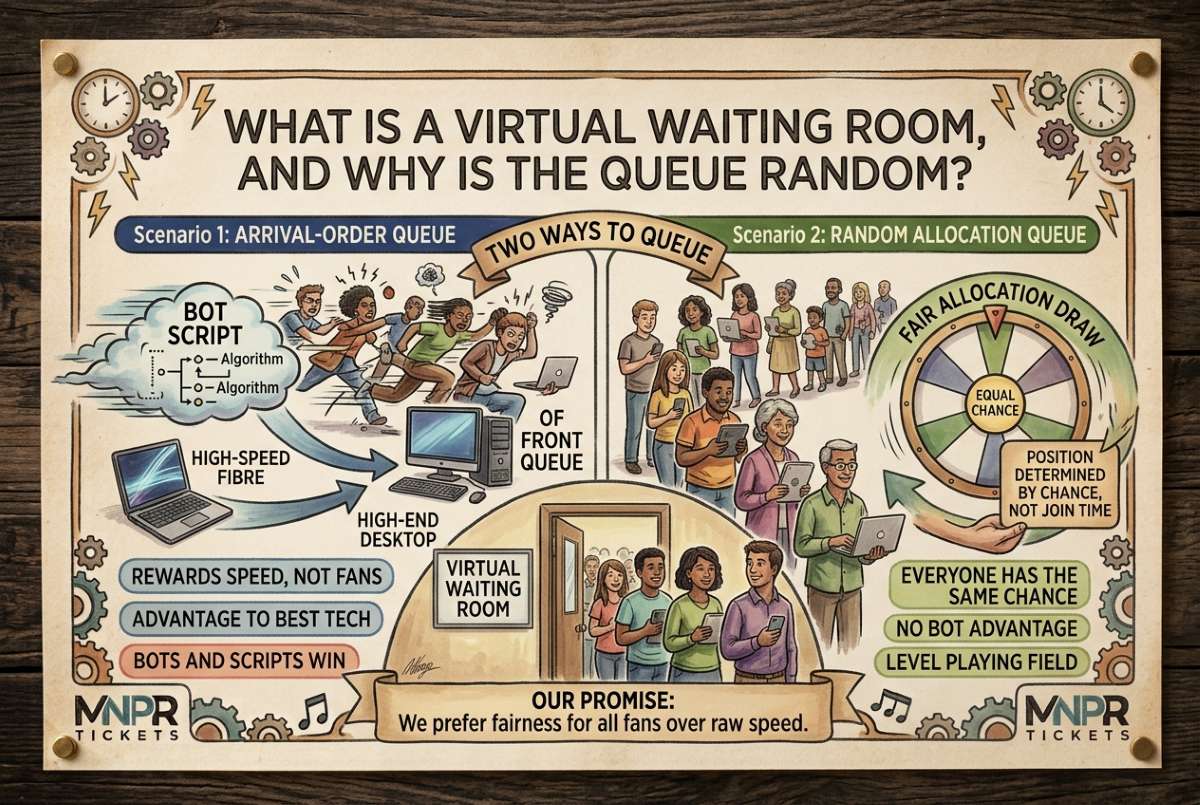
The Hidden Flaw of "First Come, First Served"
"Whoever arrives first should go first" sounds like the definition of fairness. In practice, an arrival-time queue doesn't reward fairness—it rewards raw speed. And speed is never a level playing field.
Someone on hyper-fast fibre broadband with a high-end setup has a measurable advantage over someone using their phone on a lunch break with spotty signal. Worse still, arrival-order queues are precisely what automated scalping bots are built to exploit. A script can refresh and click faster than any human ever could. If speed dictates your position, you aren't competing with other fans—you're competing with technology, and technology always wins.
Relying purely on arrival speed also creates unnecessary panic, forcing people to desperately click and refresh on the exact second. That is a miserable, stressful way to buy a ticket for something you're excited to see.
Why Random Allocation Is Actually Fairer
Randomising queue positions within the initial on-sale window removes speed from the equation entirely.
It doesn't matter if your internet is blazingly fast, if your phone is brand new, or if a bot tried to enter the queue milliseconds before you. Whether you joined the moment the window opened or a minute later, everyone inside that initial window gets an genuinely equal shot.
It might not always feel fair in the moment—especially if you logged on early and ended up further back. But a system where everyone has an equal chance regardless of their tech setup is fundamentally fairer than a system where whoever has the fastest connection wins.
What This Means for You on On-Sale Day
Don't panic-refresh. Constant clicking doesn't give you a better spot; it just adds stress.
Don't stress over milliseconds. As long as you enter the waiting room within the on-sale window, your odds are identical to everyone else in that initial wave.
Take your time. Racing the clock doesn't give you an edge, which is precisely the point.