Why We'll Never Do Dynamic Pricing
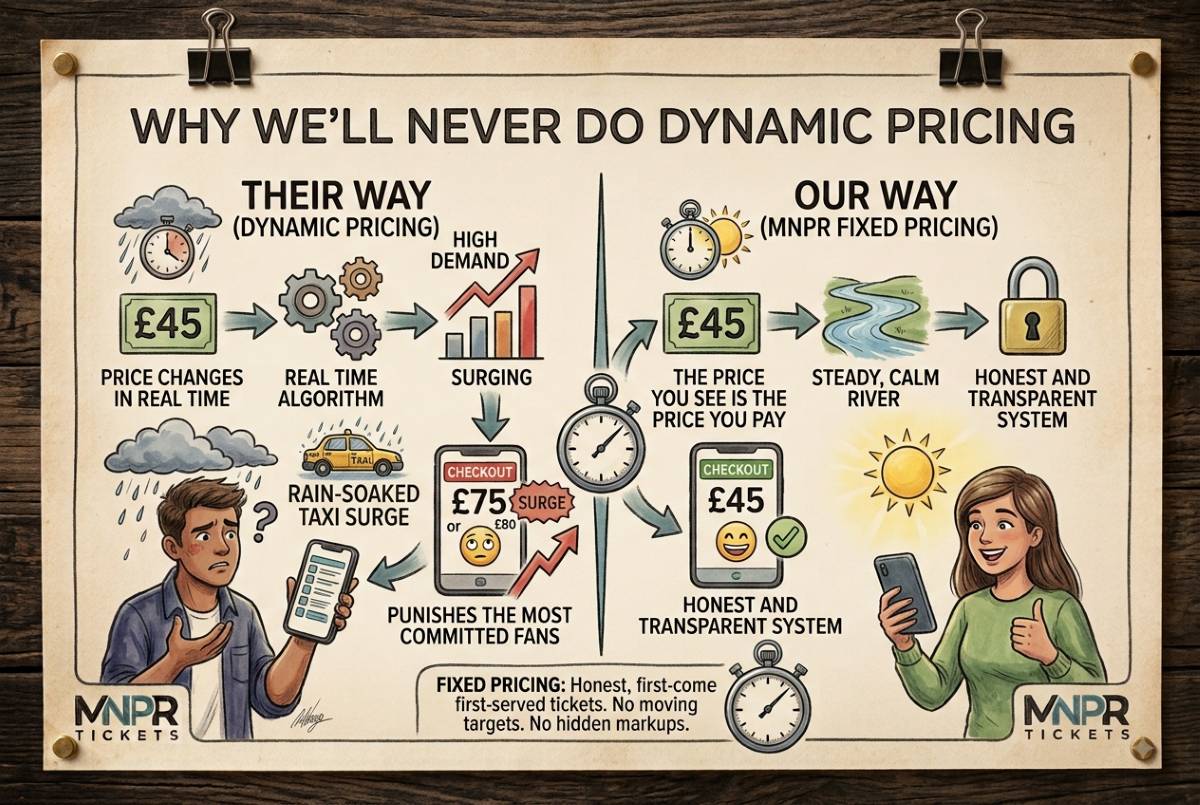
You've probably felt it happen, even if you didn't know what to call it. You find a ticket listed for £45, hop into the queue, and work your way through the checkout steps. But by the time you reach the payment screen, the price has quietly jumped to £70. Nobody warned you. Nothing on the page explained why. It just happened.
That's dynamic pricing—sometimes dressed up with softer names like "demand-based pricing" or "platinum tickets."
We will never do it. Not as an occasional feature for high-demand tours, not as an opt-in setting for promoters, and not as a experiment down the line. Ever.
What Dynamic Pricing Actually Means
Dynamic pricing means a ticket's price changes in real time based on how much demand an algorithm thinks it is seeing. The exact same seat can cost completely different amounts purely depending on how many other fans happened to be clicking "buy" at the same moment as you.
It's the same logic behind surge pricing for a taxi in the pouring rain. The difference is that a taxi ride is something you can delay or walk away from. A gig is an experience you’ve been looking forward to for months—and the price moves against you precisely when you have the least leverage to do anything about it.
Why the Industry Uses It
The honest answer? It extracts more money.
When demand peaks, legacy systems exploit fans who are already emotionally committed to going. You’ve already told your friends, arranged the travel, or sorted out a babysitter. By the time that £45 ticket becomes £70 three steps into checkout, the system relies on the fact that you won't walk away on principle.
That isn't a glitch in the software. It is the entire business model.
Why It Fails Our Core Test
When we built MNPR Tickets, every feature was held to one simple standard: does this stop someone who genuinely wants a ticket from getting one, for reasons that make no sense?
Dynamic pricing fails that test completely. It doesn't just create friction; it actively penalises the most dedicated fans at the exact moment they are most excited to buy.
There is also a fundamental lack of transparency behind it. A price that shifts while you're looking at it isn't really a price—it's a moving target, and the only party benefiting from that confusion is the one setting the trap.
What You Get With Us Instead
With MNPR Tickets, the price you see when you land on the page is the price you pay at checkout. If ten thousand people try to buy tickets at the exact same second, the price doesn't budge an inch.
Instead, the process remains genuinely simple: tickets are sold on a straightforward first-come, first-served basis. Missing out on a popular show never feels great, but a fair, fixed system is honest in a way dynamic pricing was never designed to be.
What Happens If a Promoter Asks for It?
Some artists and promoters genuinely request dynamic pricing for their events. If that is a non-negotiable requirement for them, we simply won't host their show. It isn't a threat; it's just where our boundary sits.
Besides, it isn't a feature we could switch on even if we wanted to. Dynamic pricing was never built into our code, and it never will be. There is no hidden toggle in our system settings and no secret enterprise tier. The tech simply doesn't exist on our platform.
We would rather sell every ticket at a fair price that stays put, than squeeze extra cash out of the fans who care the most.